Memory
Four kinds at once: what happened, what things mean, who the robot is, and what it is doing right now. The hard part is not storing but forgetting, letting the unimportant fade so that what remains stays usable across thousands of hours.
Olivaw builds cognition as a service: the mind a robot runs on, made to work on hardware other people build. Robots can already move, see and follow a plan. What they still lack is the part that remembers, holds a character, and works out what to do when no rule quite fits.
Motors, sensors and planners have serious groups and serious money behind them, and they improve from one month to the next. The layer above them, the one that decides what the machine actually does, has had the least attention and is the hardest to build. That layer is the whole of the lab's work, and it is not tied to any manufacturer's hardware. A mind that ran on only one body would be a feature of that body rather than a mind.
Cognition is not a single capability. Six parts make up what the lab builds, and they run together rather than one after another.
Four kinds at once: what happened, what things mean, who the robot is, and what it is doing right now. The hard part is not storing but forgetting, letting the unimportant fade so that what remains stays usable across thousands of hours.
A self-model and a decision architecture that carry identity, disposition and personality through a long run, so the robot is the same one tomorrow as it was today rather than a fresh program wearing the same body each morning.
Values weighed in the moment of deciding, rather than an action checked against a rulebook after the fact. Competing considerations stay side by side instead of collapsing into one score, and the hardest cases go to a person.
Reading how someone feels from the way their signals shift over time, through situation and culture, rather than matching a fixed expression to a label. The robot also carries a state of its own, which colours what it notices and what it does next.
A robot learns from what every other robot has met, and decides for itself what to pass on and what to keep back, so that it belongs to the common store without dissolving into it.
The mind is the part worth attacking. Protection against hijack wraps every component and every channel rather than sitting beside them as one more module. Nobody should have to operate a mind that can be taken over.
A robot working in human space is more likely to be talked into something than broken into.
A rule set cannot close that. Rules are a finite list, so they can be probed, and each rule written tells an attacker exactly what was checked. The way through is the case nobody thought to write down. Deterministic constraints fail in the same place: they hold for the situations they were given, and have nothing to say about the one they were not.
Weighing a request against everything the robot cares about leaves no such gap to find. The evaluation is general, so an approach nobody anticipated is still weighed on what it would cost and who it would fall on, and when the stakes climb the robot escalates rather than deciding alone, first to a peer and then to a person. None of this replaces the ordinary protections around a mind that can be tampered with. It closes a door those protections were never able to reach.
Robotics has used the same three-layer architecture since the 1990s: reflexes and balance at the bottom, then perception and skill execution, then planning and world models. Together those three are what a robot operating system already is. The mind is a fourth layer above them, and it is the only one the lab builds. It talks to the three below through a specified interface, in both directions.
A new stack takes the bottom three layers from a field that has solved them well, and the fourth from here, instead of writing a mind from scratch alongside everything else it already has to get right.
An existing robot operating system keeps its motor control, its perception and its planning, and attaches at the boundary between planning and the mind. Nothing underneath has to be replaced.
The lab runs an iCub3, a PAL biped and a Unitree G1: three manufacturers and three software stacks, so the same mind has to work across hardware with almost nothing in common. That is a condition of the work rather than a port attempted later.
The layers underneath can be built and tested in isolation. This one cannot. Memory that holds a self together, judgement inside human ambiguity, knowing when to step in and when to leave someone alone: none of that has an answer that can be written down in advance and verified on a test floor.
A mind forms by meeting consequences, and a consequence has to fall on someone real, in a real place, to count for much. In a simulator a mistake comes back as a number. In a town it comes back as a shopkeeper's irritation, and the shopkeeper is there again tomorrow.
One programme in two places, each doing what the other cannot.
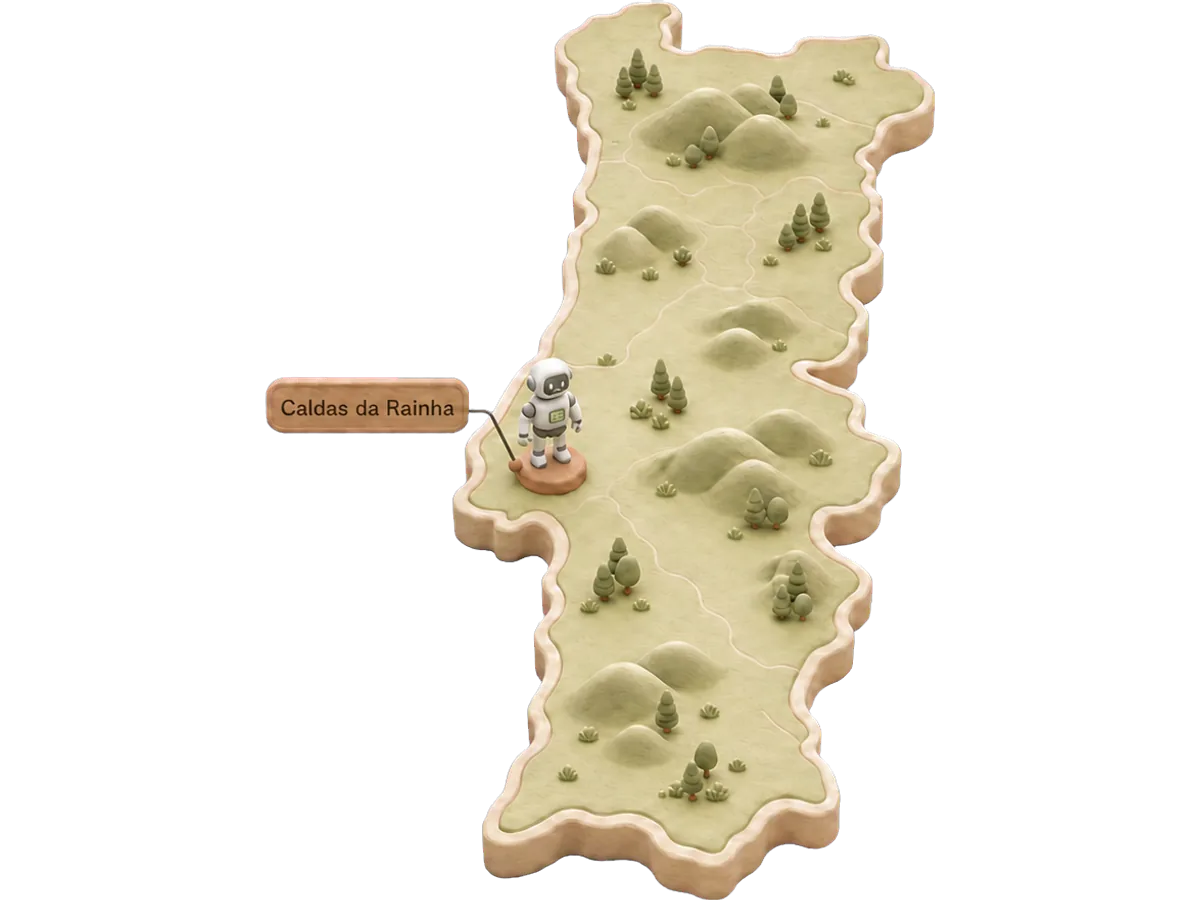
Portugal. Where the mind is grown. Robots live in a working town of fifty thousand people, with a daily market, a hospital, schools and streets, and their life there is the research rather than a trial that follows it. The consequences are real and cannot be arranged, and the build cycle is short enough that what fails on Tuesday is different by Thursday.
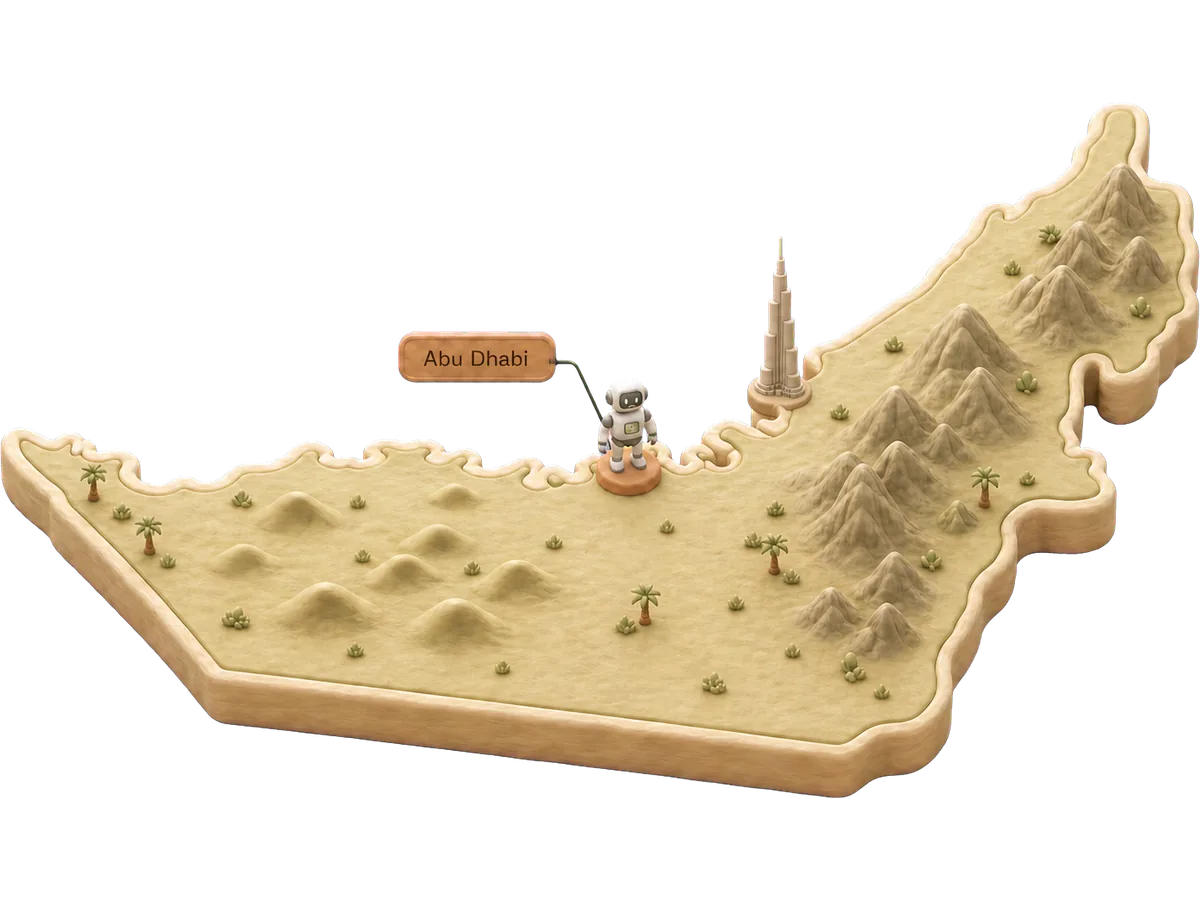
United Arab Emirates. Where the mind becomes a product. The cloud infrastructure it runs on, the repeated testing that shows it behaves the same way twice, and the floor where partners watch it work, talk to the technicians, and fit it to hardware of their own.
Two clocks run at different speeds. Hardware improves from one month to the next, and the models underneath it improve as quickly, so what a robot can physically do keeps extending. A mind cannot be hurried to match. It forms out of a long accumulation of real experience, and that takes the time it takes; neither money nor extra hands compresses it. So the slow work starts now, while there is still room to do it carefully, in the open, and with the people who will live alongside the result.